
What to Look for in a Defense Contract Manufacturer
Most defense contract manufacturers will tell you they deliver on time and on spec. That is the baseline. The harder question is whether the spec was right in the first place, and whether the shop you are working with has the experience and the standing to tell you when it is not.
That gap between a conforming part and a useful one is where defense programs quietly fail. Requirements get written without the end user in the room. Drawings go out before the manufacturing implications have been thought through. A shop executes perfectly and delivers something that does not solve the problem. Nobody did anything wrong, and the program still stalls.
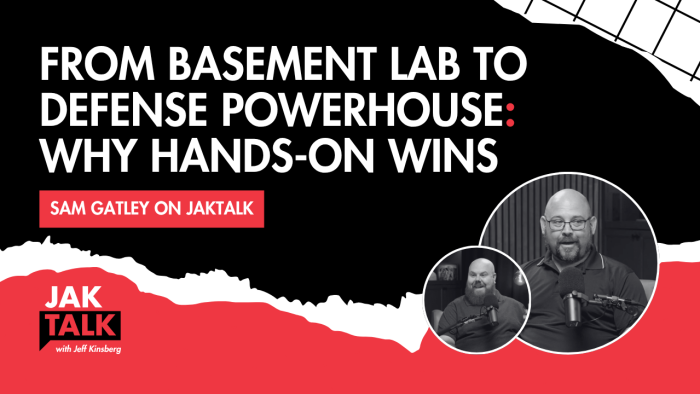
JAKTOOL works with DoD program managers, primes, and defense developers from first concept through range-validated production. A recent JAKTALK conversation with Sam Gatley, who spent nearly a decade building COMET into a 20,000-square-foot advanced manufacturing facility in partnership with Picatinny Arsenal, put many of these dynamics into focus. What follows is what we look for, and what we think you should look for, in a defense contract manufacturer.
Do They Get Upstream, or Just Execute?
Sam described a program that developed an energy-harvesting rucksack for soldiers in the field. The concept was sound on paper. Engineers built a dynamo that would capture kinetic energy from walking. In practice, the mechanism generated noise in a tactical environment where silence matters, requiring the rucksack to bounce, which soldiers are trained to avoid. The program was scrapped after significant investment.
The engineers had never marched with a rucksack. The soldiers who did were never in the room when the requirement was written. That is a requirements problem, not a manufacturing problem. But a defense contract manufacturer with real experience in this space would have flagged it. They would have asked who the end user is, what the operational environment looks like, and whether the concept has been validated by the people who have to use it.
The best defense contract manufacturers do not wait for a finalized drawing to raise concerns. They ask questions early, push back on requirements that do not reflect operational reality, and incorporate manufacturing constraints into the design process before they become expensive problems. If a shop’s only question is when you need it delivered, that is worth noticing.
Can They Bring a Network to the Table?
Prime contractors win programs by assembling the right team. A capable defense contract manufacturer understands this and acts accordingly. The ADAPT program that Sam helped manage at NJII a decade ago is a useful illustration.
ADAPT brought together roughly ten small businesses, including a battery developer, a printed electronics manufacturer, antenna researchers, and testing specialists, with Picatinny Arsenal as the government customer. None of them could have delivered the full system independently. Together, using shared contract vehicles that reduced the friction of government engagement, they delivered prime-level capability at a cost that a traditional large contractor could not match.
The reason it worked was early alignment. The fabricator, the researcher, and the field user were in the room before the design was locked. Problems that would have surfaced as expensive rework in production were caught in conversation. That kind of collaboration does not happen by accident. It requires a shop that knows how to build and manage relationships across the defense ecosystem, not just one that can machine a part to tolerance.
When you are evaluating a defense contract manufacturer, ask who they work with. Ask whether they have existing relationships with government labs, research institutions, or complementary suppliers. A shop with a strong network can do more for a program than a shop with better equipment.
Do They Know When the Spec Is Wrong?
Technical data packages are written to remove risk. That is their purpose, and it is a legitimate one. The problem is that requirements written to eliminate all risk often eliminate the solutions that would actually work in the field.
The question worth asking is whether the requirement reflects the actual use case. A part that needs to survive from -40 to 120 degrees Fahrenheit over years of service life is different from one that needs to work reliably for 72 hours in a specific operational scenario. Those are not the same requirements. They should not be manufactured, qualified, or priced to the same standard. In the field, not having the part is often a worse outcome than having one that meets 90 percent of the specification.
A defense contract manufacturer that adds real value will tell you when a tolerance is tighter than the application demands, when a material specification will create supply chain problems, and when a qualification requirement has been borrowed from a different program without considering the actual use case. That kind of upstream input is what separates a manufacturing partner from a vendor.
Can They Take You from Prototype to Production?
Getting a prototype approved is one problem. Taking it to Low Rate Initial Production is a different matter entirely, and it is where many defense programs stall.
Prototype work is forgiving. The objective is to prove a concept and get something in front of a customer. LRIP is not forgiving. Every part needs a pedigree. Material traceability is not optional. The process has to be repeatable by people who were not in the room when the prototype was built, and it has to be documented to a standard that will survive a government audit. Schedule pressure that was manageable during development becomes acute.
A lot of that pressure comes from accountability gaps. A prototype built across a loose network of vendors, each owning one piece of the process, rarely produces the documentation trail that LRIP requires. When something does not perform as expected, tracing the cause through divided ownership is slow and expensive. The shops that make the transition well are the ones that treated production discipline as a requirement from day one, not something to retrofit after the prototype was approved.
AS9100 and ITAR registration matter here not as compliance requirements but as indicators of how a shop operates. They reflect whether a shop has built the infrastructure that a prime contractor needs before handing over a production contract.
JAKTOOL’s capability spans concept and design, simulation, precision machining, fabrication, and range-validated testing. That breadth exists because the prototype-to-production transition is where we see programs fail most often. When the team that designed the part is the same team manufacturing it at volume, problems get caught in the design review rather than after the first production run.
The Right Partner Asks Hard Questions
The defense contract manufacturers worth working with are not the ones that execute quietly and stay out of your way. They are the ones that push back on requirements that will not survive contact with the field, bring a network to programs that need more than one shop, and have the production infrastructure to take a good prototype all the way to a fielded capability.
That is what JAKTOOL does. If you are a program manager evaluating partners, a prime looking for a shop at the right scale, or a defense developer trying to close the gap between prototype and production, we want to talk.
Watch the JAKTALK conversation that informed this article: From Basement Lab to Defense Powerhouse: Why Hands-On Wins.