
Surviving the Valley of Death: What Non-Traditional Defense Contractors Need to Know
Defense innovation is often discussed in terms of new technologies, faster acquisition, and getting capabilities into the hands of the warfighter. But moving an idea from promising technology to a sustainable defense program depends on something more fundamental: understanding how government and industry actually work together.
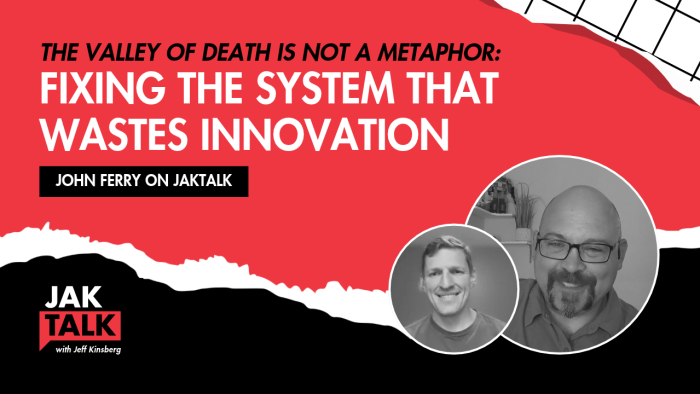
On this episode of JAKTALK, Jeff Kinsberg sits down with John Ferry, author of The Valley of Death Survival Guide, to discuss why promising companies and technologies can struggle to gain traction in defense. Their conversation explores the incentives shaping government and industry, defense acquisition reform, barriers facing non-traditional defense contractors, weaknesses in the defense supply chain, and the role emerging technologies like AI could play in acquisition.
Government and Industry Need to Understand Each Other
One of the central challenges in defense acquisition is that government and industry operate under different incentives.
Companies entering the defense market may focus heavily on their technology, their capabilities, or the contracting process. But understanding who actually has the requirement, and what motivates that organization, is equally important.
The contracting officer may ultimately sign the contract, but the requirement holder is often much closer to the operational problem being solved.
That distinction matters for a non-traditional defense contractor trying to establish itself in the market. Successful defense business is built on relationships, and those relationships require understanding the people behind the acquisition process rather than treating government as a single customer.
The same principle works in both directions. Government organizations seeking new suppliers need to understand the realities facing commercial companies, including the investments, timelines, and predictability required to participate successfully in defense programs.
Better outcomes begin when both sides understand what the other needs to succeed.
Why Defense Acquisition Reform Doesn’t Change Behavior Overnight
Defense acquisition reform can introduce new policies and contracting approaches, but changing policy is not the same as changing behavior.
John describes this disconnect as an informational thermocline: priorities and reforms may be well understood at senior levels while the people responsible for executing acquisitions continue working through familiar processes.
There is a practical reason for that.
A contracting professional may have little incentive to abandon a proven acquisition path for an unfamiliar one, particularly when the potential consequences of making a mistake outweigh the benefits of trying something different.
Alternative approaches, including an OTA contract or Commercial Solutions Opening, can give government organizations additional ways to work with commercial and non-traditional companies. But simply creating those pathways does not guarantee they will be used.
Effective defense acquisition reform depends on more than introducing new authorities. The people responsible for executing the work need the knowledge, incentives, and confidence to use them.
The Valley of Death Is More Than a Funding Problem
Emerging defense technologies tend to move through cycles of intense attention.
Different periods have brought increased focus to counter-IED technology, big data, artificial intelligence, unmanned systems, and counter-UAS capabilities. Those priorities can create significant opportunities for defense tech startups and established companies entering new markets.
But the most visible technology is only part of what is required to field a capability.
Every new system creates adjacent engineering and manufacturing needs. Packaging, components, testing, integration, maintenance, training, and production all become part of turning promising technology into something that can operate reliably in the field.
Organizations also face another risk: relying too heavily on a single internal champion.
People change assignments and responsibilities. When one individual represents the entire connection between a company and a government organization, that relationship can become a single point of failure.
Crossing the Valley of Death therefore requires more than securing initial interest. Companies need to build broader understanding of the requirement, the organization, and the path from prototype to sustained capability.
The Defense Supply Chain Depends on the Suppliers Behind the System
The barriers to entering defense can accumulate quickly.
Cybersecurity requirements, accounting systems, contract vehicles, past performance, and other qualifications can each become another hurdle companies are expected to clear before participating.
Those requirements exist for reasons, but collectively they can make it difficult to expand the defense supply chain.
During the conversation, Jeff raises a practical defense contract manufacturing question: if a company sends out a request for quotation and receives only one viable bid, is the supply chain constrained or does a meaningful supply chain for that capability no longer exist?
That question becomes increasingly important farther down the supplier base.
Major defense platforms depend on networks of military contract manufacturing companies producing machined parts, castings, forgings, assemblies, and specialized components. Weakness in those second- and third-tier suppliers can ultimately become a constraint on the larger program.
Strengthening the supply chain requires looking beyond the largest defense companies and understanding the engineering and manufacturing capacity supporting them.
Rebuilding the Defense Industrial Base Requires Predictability
Manufacturers invest when they have enough confidence in future demand.
Equipment, facilities, skilled employees, quality systems, and production capacity all require capital. Suppliers are more likely to make those investments when they can see a credible path to sustained work.
That makes predictability an important part of rebuilding the defense industrial base.
Multiyear procurement is one mechanism that can provide suppliers with greater visibility into future demand. Commercial manufacturers may also represent additional capacity, particularly when government and prime contractors can create practical pathways for those companies to enter defense.
But identifying a company with manufacturing capability is only the beginning.
Defense programs can involve demanding technical requirements, documentation, quality controls, security considerations, and integration challenges. Bringing new capacity into the industrial base requires combining manufacturing capability with the defense engineering knowledge needed to turn requirements into reliable, producible solutions.
AI Works Best When the Process Comes First
Artificial intelligence is creating new opportunities across government and industry, but the conversation raises an important question: where should AI actually be applied?
Some government responsibilities inherently require human judgment and accountability. Other parts of the acquisition process may benefit from automation or AI-assisted tools.
The critical step is understanding the process first.
Jeff connects that idea to lessons from implementing enterprise software. Adding technology before understanding how information moves through an organization can simply automate an inefficient process.
The same principle applies to AI in government contracting.
Organizations first need to understand the workflow, the decisions being made, the information required, and the constraints surrounding those decisions. Only then can they determine where AI can meaningfully improve the process while keeping appropriate human judgment in the loop.
Technology works best when it is applied to a clearly understood problem.
Stronger Defense Partnerships Start With Understanding the Mission
The challenges surrounding defense innovation are rarely isolated to technology, acquisition, manufacturing, or funding.
They intersect.
A non-traditional defense contractor may have an exceptional technology but still need to understand the acquisition environment around it. Government may want access to commercial innovation but need acquisition approaches that contracting teams can execute responsibly. Manufacturers may have useful capacity but need enough predictability to justify investing in defense work.
John’s advice brings those challenges back to a straightforward principle: understand your customer’s incentives.
That mindset aligns closely with how JAKTOOL approaches defense engineering and manufacturing. Rather than beginning with a predetermined solution, JAKTOOL works to understand the requirement, technical constraints, stakeholders, and intended outcome before determining how to move forward.
For program managers, prime contractors, engineers, and organizations working to strengthen the defense industrial base, better collaboration begins with understanding the problem from the other side of the table and building a path forward together.
Watch the JAKTALK episode that informed this article: https://youtu.be/rSX4qqVTwto?si=MmxRKbWoWKQ0XxnU