
What Mission Command Can Teach Us About Defense Acquisition
Defense acquisition has a difficult job.
The system must manage public resources responsibly, maintain accountability, address technical and operational risk, and ultimately deliver capabilities that work for the people who depend on them. Those responsibilities require structure.
At the same time, complex engineering programs rarely follow a perfectly predictable path. Requirements evolve. Testing reveals new information. Technologies mature. Budgets and operational priorities shift.
The challenge is not choosing between structure and flexibility. It is building a system capable of both.
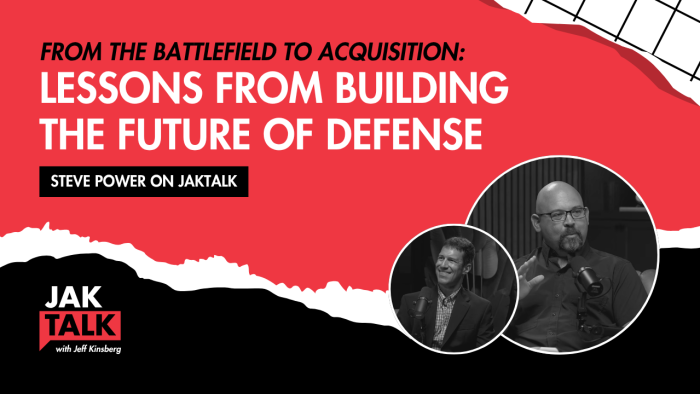
That tension came up during a recent JAKTALK conversation with Colonel Steve Powers, Ret., a former Army acquisition leader with decades of experience, where he discussed the Army concept of mission command. Although mission command comes from an operational context, its principles offer a useful framework for thinking about acquisition and engineering organizations.
Defense acquisition requires accountability and disciplined processes. But clear purpose, a defined end state, and trust in capable people can help ensure those processes remain focused on what ultimately matters: delivering the best outcome for the end user.
Mission Command: Define the Goal, Then Trust the Team
Army Doctrine Publication 6-0 describes mission command as an approach to command and control designed for environments characterized by change and adaptation. At its core are three important questions:
What is the task? What needs to be accomplished?
What is the purpose? Why does it need to be accomplished?
What is the desired end state? What does success look like?
Those questions establish direction without attempting to prescribe every decision a team will encounter along the way.
Mission command recognizes that people closest to a problem will inevitably encounter information leadership could not have anticipated. Leaders establish intent and objectives, while trained people use judgment to respond to changing conditions.
That does not mean abandoning leadership or accountability. It means providing clear direction while trusting qualified people to make informed decisions within it.
Applying Mission Command to Defense Acquisition
During the JAKTALK episode, Powers described an acquisition environment where changing a requirement, budget, or strategy can sometimes require decisions from levels far removed from the engineers, program personnel, operators, and specialists working directly with the problem.
There are good reasons for oversight. Acquisition decisions can involve significant public resources, operational risk, and consequences extending beyond an individual program.
But additional layers of control can introduce another kind of risk; when new information emerges, the people who understand it best may not have the authority to respond. Teams can spend more time navigating the process required to make a change rather than pursuing the change that best supports the mission.
Powers illustrated the challenge with a useful analogy: reform should involve a scalpel rather than a chainsaw.
Broadly eliminating people or processes risks removing institutional knowledge, technical expertise, and mission commitment along with inefficiency. A better approach is to identify where processes provide necessary accountability and where they create barriers without proportionate benefit.
The objective is not an acquisition system without oversight. It is one where accountability and adaptability can coexist.
Why Engineers Need to Understand the “Why”
The same principle matters at the engineering level.
There is an important difference between receiving a requirement and understanding the purpose behind it.
Requirements provide necessary technical direction, but they do not always communicate why a particular constraint exists. That context becomes increasingly important once development begins.
Engineering is a process of learning. Prototyping challenges assumptions. Testing exposes failure modes. Manufacturing introduces constraints. Integration reveals interactions that may not have been obvious on paper.
If engineers understand only the requirement, their task is to satisfy it. If they also understand its purpose, they can evaluate new information against the actual user need.
For example, when testing reveals an unexpected tradeoff, the team can ask whether the original requirement remains the best way to achieve the intended outcome. They can bring evidence back to program leadership and explain not simply that something should change, but why a change could produce a better result.
That is not an argument for disregarding requirements. It is an argument for giving technical teams enough context to recognize when new evidence matters.
This also connects to JAKTOOL’s Advanced Innovation Methodology (AIM®). A disciplined engineering process should create opportunities to learn through analysis, prototyping, testing, and iteration. What the team learns should inform the next decision while keeping everyone aligned with the desired outcome.
Process provides structure. Evidence provides feedback. Purpose keeps both pointed in the right direction.
Keep the Process Focused on the Mission
Defense acquisition needs requirements, accountability, documentation, and disciplined decision-making. But complex engineering programs cannot eliminate uncertainty.
New information will emerge. Assumptions will change. Tests will fail. Operational needs will shift.
Mission command offers a useful principle for navigating that reality: give qualified people a clear mission, make sure they understand its purpose and desired end state, and enable them to exercise sound judgment as conditions change.
Applied thoughtfully, that principle does not weaken acquisition discipline. It helps keep the organization aligned around the reason the process exists in the first place.
The strongest acquisition systems will preserve necessary accountability while allowing technical expertise, institutional knowledge, and new evidence to meaningfully inform decisions.
Because ultimately, the process is not the mission.
The process should support the people accomplishing the mission, not distract them from the outcome the process was created to achieve.
Hear more of Steve’s perspective on mission command, engineering, and defense acquisition in the full JAKTALK episode.