
From Requirements to Results: Rethinking Defense Acquisition, Innovation, and Readiness
By JAKTOOL Engineered Solutions
Defense acquisition is often discussed in terms of technology, timelines, and requirements. But delivering the right capability to the warfighter depends on something more fundamental: understanding the problem that needs to be solved.
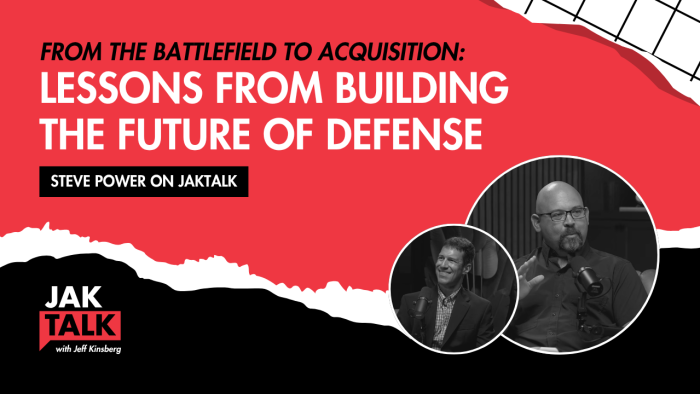
On this episode of JAKTALK, Jeff Kinsberg sits down with Steve Power, a former Army acquisition leader with decades of experience across requirements, program management, research and development, and production. Their discussion highlights challenges that can emerge across defense manufacturing and acquisition, from requirements that become disconnected from operational needs to the difficulty of adapting programs as technology and threats change.
When Requirements Lose Their Purpose
One of the biggest challenges in acquisition is the distance that can develop between the people defining a requirement and the people who use the capability.
Steve points to the difference between large organizations and communities where acquisition professionals and user representatives work in close proximity. When those groups can communicate directly, they have more opportunities to clarify what a requirement actually means and why it exists.
In larger organizations, that connection can become more difficult. A requirement may move through multiple levels of review before it becomes an approved document. By the time an engineer or manufacturer has a question, the person who originally wrote it may have limited ability to clarify what was intended.
The result is a familiar problem: the document becomes the driving force, even when the intent behind the document may have changed.
That makes communication and proximity to the end user critical. The goal is not simply to follow a requirement. It is about understanding the purpose behind it and delivering the outcome the warfighter actually needs.
Risk Management Requires Looking Ahead
Another major theme is the difference between managing today’s problems and preparing for tomorrow’s challenges.
Teams often describe their risk management activities by listing the crises and issues they are currently working to resolve. Those activities are important, but Steve makes a distinction: that is crisis management, not risk management.
Real risk management requires teams to use their imagination to consider what could happen next. That means identifying potential threats before they become problems, but it also means looking for opportunities.
What new technology could change the program? What assumption might prove incorrect? What option could become available? What could the team do differently if circumstances change?
Thinking through those possibilities in advance gives teams more options when unexpected situations arise.
That forward-looking approach also creates a need for flexibility.
Programs Need Room to Adapt
Defense contracts exist to establish clear expectations, but overly rigid requirements and contracts can make it difficult to respond when new opportunities emerge.
That tension becomes especially apparent when moving from research and development into production. R&D programs often have more flexibility because the work itself involves exploration and uncertainty. Production contracts, particularly for mature products, tend to be much more tightly defined.
Yet new technologies and better approaches continue to emerge simply because a program has moved into production.
Building appropriate flexibility into contracts can give government and industry a mechanism to respond when a better solution becomes available. Without that room to adapt, even a valuable improvement can become difficult to implement because changing the scope requires significant time and renegotiation.
That does not mean removing rigor from acquisition. Flexibility has costs and must be managed carefully. It means creating enough room for teams to respond when reality does not match the assumptions made at the beginning of a program.
AI Is Only as Good as the Knowledge Behind It
Artificial intelligence is becoming increasingly relevant to defense manufacturing, but its value depends on the knowledge and data behind it.
Steve’s perspective is more nuanced than simply asking whether AI will transform the industry. The more important question is where AI can actually provide value.
AI can be highly effective for specific applications, particularly when there is a strong body of data and knowledge to draw on for the task. Manufacturing inspection is one example. Processes such as X-ray inspection generate large amounts of data and require highly trained personnel to identify potential issues. Computer vision and other AI-enabled technologies may assist with repetitive inspection tasks, allowing experienced personnel to focus on more complex work.
The challenge arises when organizations treat AI as a solution before establishing the necessary information to make it useful.
If an organization has not captured its processes or does not have access to reliable supply chain data, simply adding AI does not solve the underlying problem.
The same principle applies to institutional knowledge. As experienced personnel retire or move into different roles, organizations risk losing decades of knowledge. Capturing that expertise and using it to train and guide emerging technologies could allow AI systems to become more useful over time.
The takeaway is simple: AI is not a substitute for knowledge. It is a tool for using knowledge differently.
Ask Why. Manage Risk. Use Imagination.
Three principles from Steve’s experience apply well beyond defense acquisition.
First, be a good teammate and do the right thing. Relationships and trust matter, particularly in an industry where programs can span years and involve countless organizations.
Second, ask why. Understanding why a requirement exists, why a process works a certain way, or why a particular assumption was made can reveal opportunities that would otherwise remain hidden.
Finally, use imagination. Innovation does not always begin with having more resources. Sometimes it begins with looking at the resources available and asking what else might be possible.
Taken together, these principles point back to the same idea: effective acquisition depends on understanding the purpose behind the work and staying willing to question how it gets done.
The Right Approach Starts With the Mission
Effective defense acquisition requires more than following requirements, completing contracts, or moving programs through established processes. It requires understanding the purpose behind the work, asking the right questions, and recognizing when a different approach may produce a better result.
That mindset is central to how JAKTOOL approaches defense manufacturing and engineering. By combining manufacturing experience with engineering expertise, JAKTOOL works with customers and partners to develop practical solutions that address real operational needs.
For program managers, prime contractors, engineers, and defense organizations working to move capabilities forward, that means working with partners who can do more than execute to a specification. They need to understand the purpose behind the requirement, ask questions when circumstances change, and help turn requirements into practical solutions.
Watch the JAKTALK episode that informed this article: https://youtu.be/fseOzsEOB5Q