
Engineering for the Department of Defense is Changing
For most of the 20th century, the defense industrial complex ran on a simple premise: if the military needed something, someone would custom-build it. Long development cycles. Bespoke specifications. Massive R&D investment. A few primes with the clearances, relationships, and capital to play.
That model produced extraordinary things. It also produced $600 toilet seats, 20-year procurement timelines, and systems that were obsolete before they reached the field.
Something is changing. In November 2025, Secretary of Defense Pete Hegseth told defense industry executives: “The defense acquisition system, as you knew it, is dead.” The Department followed with a formal Acquisition Transformation Strategy mandating a shift from requirements-based to solutions-based procurement, expanding the use of Other Transaction Authorities, and directing the DoD to increase reliance on commercial products and technologies.
For defense contractors, adapting to this new landscape starts with immediate action. Leaders should review internal procurement and development processes to identify opportunities to replace bespoke builds with commercial solutions. Teams should assess current and future projects against the Acquisition Transformation Strategy and highlight where COTS technology could make an impact. Proactively map commercial opportunities, increase communications with commercial vendors, and ensure engineering teams work closely with end-users early in the design process. Taking these steps now positions organizations to meet the Department’s evolving expectations and gain a competitive edge.
In plain terms, the Pentagon wants what works, delivered fast, at a price that makes sense. Custom development for its own sake is no longer the default. Commercial Off-the-Shelf technology — known in the industry as COTS — intelligently adapted to mission requirements, is increasingly the right solution.
For companies like JAKTOOL, this is both a signal and a challenge. We have built COTS-rooted solutions in defense before and seen what that approach produces. But meeting the demands of this new acquisition environment means leaning into that model more deliberately and at a greater scale than we have before. The contractors competing for this work aren’t the ones who have done it occasionally. They’re the ones who have committed to it.
What COTS Actually Means in a Defense Context
Commercial Off-the-Shelf technology gets misunderstood in defense conversations. Critics frame it as cutting corners, but in reality, it is far more nuanced and interesting.
COTS doesn’t mean buying a consumer product and bolting it to a military vehicle. It means starting from a platform that has already been designed, tested, manufactured at scale, and proven in the commercial market, then reimagining its application, hardening it for the environment it will actually operate in, and integrating the mission-specific interfaces that make it useful to a warfighter.
The commercial technology sector moves faster than defense procurement and always has. Consumer electronics, sensors, communications hardware, and control interfaces: the civilian market constantly iterates. A defense contractor who bridges that gap and configures what’s already working for the mission gains a speed and cost advantage that bespoke development cannot match.
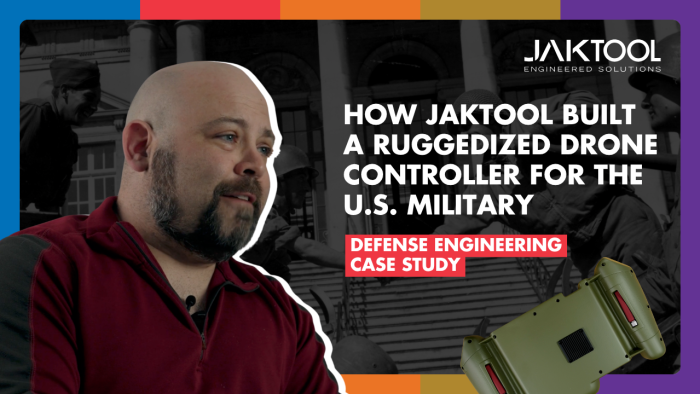
This is what JAKTOOL did when a U.S. government customer asked them to develop a ruggedized battlefield controller for an unmanned ground vehicle. The customer wanted a video-game style handheld interface, purpose-built for soldiers in combat. JAKTOOL didn’t design a controller from scratch. We identified the right commercial starting point, understood the warfighter’s environment, and engineered the gap between the two.
The result came in considerably under the customer’s original budget. More importantly, it worked.
Designing for the Person Holding It, Not the Spec Sheet
There’s a version of COTS adoption that misses the point. You take a commercial platform, make minimal changes to keep costs down, and hand it over. It meets the spec but fails the mission.
It failed because no one spoke to the warfighter.
Soldiers in a theater of conflict do not operate under the same conditions as the engineer who wrote the requirements. They work under battle stress and wear gloves. Screens that perform well under office lighting can become unreadable under sunlight glare. Interfaces designed for bare-fingered precision become unusable when fine motor control is compromised by adrenaline, cold, or protective gear.
These aren’t edge cases. They are the use case.
JAKTOOL’s approach required direct engagement with warfighter feedback throughout the design process, not just at the end as a validation check. Engineering decisions, interface choices, and physical form factor were all stress-tested against what soldiers experience in the field, not what looks right in a lab.
This is where the COTS philosophy gets its teeth. The commercial technology provides speed and cost efficiency. The engineering judgment, applied to the specific human being who will be in a dangerous situation, is what makes it worth fielding.
What the New Acquisition Environment Actually Rewards
The DoD’s Acquisition Transformation Strategy, issued in late 2025, makes the direction clear. The Department wants contractors who bring solutions to operational problems quickly, not just comply with spec sheets over long timelines. It wants increased use of commercial products and services. It wants Other Transaction Authorities as a standard tool, not an exception. OTAs are designed to speed up the procurement process by providing flexible agreements outside the traditional Federal Acquisition Regulations, thereby eliminating red tape and enabling faster prototyping, negotiation, and delivery of needed capabilities. For contractors, this means fewer bureaucratic barriers, simplified contracting, and more opportunities to bring innovative commercial technology directly to the mission. The Department wants companies that operate at high speed.
Contractors who built their identity on proprietary development, long-standing sole-source relationships, and the assumption that the government would wait are the ones Hegseth warned about. Contractors who have spent years learning to take commercial technology seriously, adapt it intelligently, and deliver fast are the ones the new model rewards. JAKTOOL has operated in that space for a long time, not because we anticipated a policy shift, but because it is often the right way to solve engineering problems. Start from what works. Understand the environment. Close the gap with engineering judgment, warfighter input, and the willingness to tell a customer or colleague that they are wrong.
That is not a new strategy. But it’s finally the one the DoD is asking for.
The Engineering Work That Proves It
The drone controller project is not Jaktool’s only COTS-rooted defense program. It is a clear example of what the model produces when it is executed well.
A government customer with a real operational need. A commercial technology platform with the right foundation. Engineering judgment applied to the specific demands of the battlefield environment. Honest engagement with a customer whose original approach needed to change. A system delivered under budget, confirmed by field personnel as operational.
That is the template. Not because it is the easiest path, but because it is the one that produces technology the American warfighter can use.
The old model is not just changing; it’s being replaced. It is being actively dismantled by the people who run the Department. The question every defense contractor needs to answer right now is not whether they will adapt. It is whether they already have. If your organization has not already assessed its readiness for this new acquisition environment, now is the time. Review your teams, your processes, and your current projects. Identify where you can replace custom development with commercial solutions and where you can deepen engagement with end-users.