
Where Do Drones Go When They Die? Building Sustainable Futures in Aerospace and Engineering
Drones are no longer the futuristic novelty they once were. Today, they are everywhere, supporting military operations, surveying real estate, delivering packages, capturing cinematic entertainment, and more. A critical but overlooked question about Drones looms: what happens to drones at the end of their life cycle as their numbers climb into the millions?
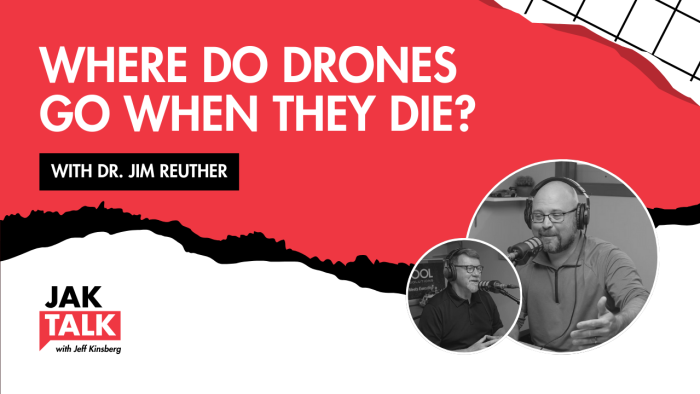
On this episode of JAKTALK, JAKTOOL founder Jeff Kinsberg sits down with subject matter expert and consultant Dr. Jim Reuther to explore the future of drone disposal, recycling, and resource recovery. Dr. Reuther brings decades of engineering and defense experience to the conversation, pushing us to think about sustainability long before the landfill crisis hits.
The Evolution of Drones Across Industries
Drones have evolved far beyond toys or military assets. They are now essential tools in logistics, agriculture, infrastructure inspection, and entertainment. Their proliferation is astonishing, with millions already in circulation, and their applications continue to expand.
Yet while innovation races ahead, end-of-life planning has barely begun. Most drones that “retire” today simply end up in landfills. The conversation rarely extends beyond performance and payload, leaving behind a mounting waste problem that the industry cannot ignore.
Environmental and Material Challenges in Drone Manufacturing
Like other electronics, drones are built from plastics, composites, metals, and rare earth elements. These materials are valuable and, in some cases, scarce. Critical components such as cobalt, titanium, and rare earth magnets are scarce and tend to come from geopolitically unstable regions.
Discarding drones wastes these resources and increases dependence on foreign supply chains. Worse, lithium-ion batteries used in drones are a growing cause of landfill fires. While some European nations are experimenting with drone recycling programs, the United States has yet to establish a clear path forward. The risk is repeating the mistakes of the past, ignoring the problem until the costs of cleanup are overwhelming.
From Lifespan to Recycling: Drone Parts Recovery
Dr. Reuther argues that the best time to plan for disposal is during design. As product engineers now build for manufacturability, they must also begin designing drones for disassembly.
Possible solutions include:
- Modular construction that allows easy removal of components.
- QR or barcode tagging to give recyclers a ready-made bill of materials.
- Standardized interfaces that simplify the separation of batteries, sensors, and airframes.
This approach mirrors electronics recycling and extends JAKTOOL’s philosophy: solving problems over the horizon before they reach a crisis point. Designing with “the afterlife” in mind protects resources, reduces costs, and positions companies as responsible innovators.
Policy and Regulatory Pressure on Emerging Tech
The Environmental Protection Agency has already flagged drones as a source of waste and fire hazards. Without intervention, discarded airframes and batteries could soon overwhelm landfills.
Formal Department of Defense programs for drone disposal remain unclear, even though drones play a central role in modern military operations. Unless policymakers and regulators provide guidance and incentives, the industry risks falling into a familiar trap; it may become cheaper to pay fines than to comply with recycling mandates. That path leads only to bigger, more expensive cleanup efforts later.
As daunting as the problem sounds, it also presents enormous opportunities for innovation. Proof-of-concept projects could begin with student teams experimenting with robotic disassembly arms or AI-driven recycling models. Businesses may find entirely new markets in drone upcycling, materials recovery, or logistics systems.
Some of Dr. Reuther’s ideas, such as drones flying themselves to designated recycling hubs, push the imagination further. Whether practical today or not, they highlight the importance of divergent thinking in tackling a challenge that will define the next decade.
Drone Disposal: A Freight Train on the Horizon
Dr. Reuther describes drone disposal as a “freight train” barreling toward industry. The issue feels abstract now; landfills are still managing, regulators are still quiet, and manufacturers are still focused on performance. But with drone populations multiplying, a tipping point is inevitable.
The sooner engineers, policymakers, and industry leaders confront this challenge, the better prepared we will be. The alternative is scrambling for solutions in the middle of a crisis.
Innovation with Responsibility
Drones are not disposable toys. They are complex, resource-rich technologies that deserve responsible end-of-life strategies. The industry must begin planning through better design, smarter regulation, and bold innovation before the problem becomes unmanageable.
At JAKTOOL, foresight is part of the mission. By spotlighting challenges like drone disposal before they escalate, JAKTOOL continues to advance its role as a trusted partner in solving engineering problems that matter most.
The takeaway is clear: Innovation does not end at deployment. Responsible drone engineering means planning for the full lifecycle, including what happens after the mission is completed.